
A friend of mine tops up ₹500 on a Friday night, loses it in twenty minutes, tops up again “to make it back”, and goes to bed ₹1,500 down. He does that most weeks and would tell you, honestly, that he “barely gambles”. He has never once added up the year.
That gap between what people think they spend and what the ledger says is exactly why a leaked figure out of Chile is worth reading carefully. A document leak put a number on online casino player spending in that market: roughly $48 a day per player. Before you compare yourself to it, you need to understand what the number is, what it hides, and which budgeting method actually keeps you inside your means.
A leaked number: $48 a day in online casino player spending
The figure comes from a mass leak of documents tied to the Curaçao Gaming Control Board (CGA), nicknamed the “Curaçao Papers” — more than 84,000 files linked to betting companies licensed there. Chilean media that reviewed the files found internal financial material from operators active in Chile, including the brand EstelarBet, which projected annual growth of 23.2% over three years.
Inside that commercial planning sat the player-spend line: in 2024, an online player in Chile spent about $48.22, with the operator projecting roughly $47.49 for the following four years. Two things about that deserve attention.
First, this is an operator’s own business projection for one market, pulled from leaked internal documents — not a regulator’s player survey, and not a global benchmark. Chile’s online sector, incomes and payment habits are not India’s. Second, the projection is essentially flat. Growth was expected to come from signing up more players (the leak describes sponsorships of two Chilean top-division football clubs and large influencer campaigns), not from squeezing more out of each one. That is the business model in one line: acquisition plus retention, with spend per head treated as a stable constant.
What an “average casino spend” actually tells you
Less than you would hope. An average casino spend figure is a mean, and means are fragile things in gambling data because a small group of very heavy spenders drags the number upward. If 99 players lose ₹200 in a day and one loses ₹5,00,000, the “average” player lost about ₹5,200 — a figure that describes nobody in the room.
The honest measure for “what a typical player does” is the median, the midpoint where half spend more and half spend less. In heavily skewed data the median usually sits well below the mean. The leaked material, as reported, gives an average and not a distribution, so the most defensible reading is: most players in that market almost certainly spent less than $48 a day, and a minority spent dramatically more.
There is a second ambiguity that matters even more. “Spend” can mean deposits, total amount wagered (turnover), or net losses, and those are wildly different numbers. Take a slot with 96% RTP, which means a 4% house edge. A ₹1,000 deposit that gets recycled through winnings can generate ₹10,000 or more in turnover before the balance is gone. So ₹4,000 of turnover is not ₹4,000 lost, while ₹4,000 of net losses is a very serious daily figure. Unless a data set defines its terms, treat any single spend number as a rough signal, not a yardstick.
What it does signal reliably: at roughly $1,450 a month, sustained spending at that level would consume a large slice of a typical monthly salary in almost any country, including higher-income markets. That is the useful takeaway, not the decimal point.
The 5% guideline versus the $48 reality
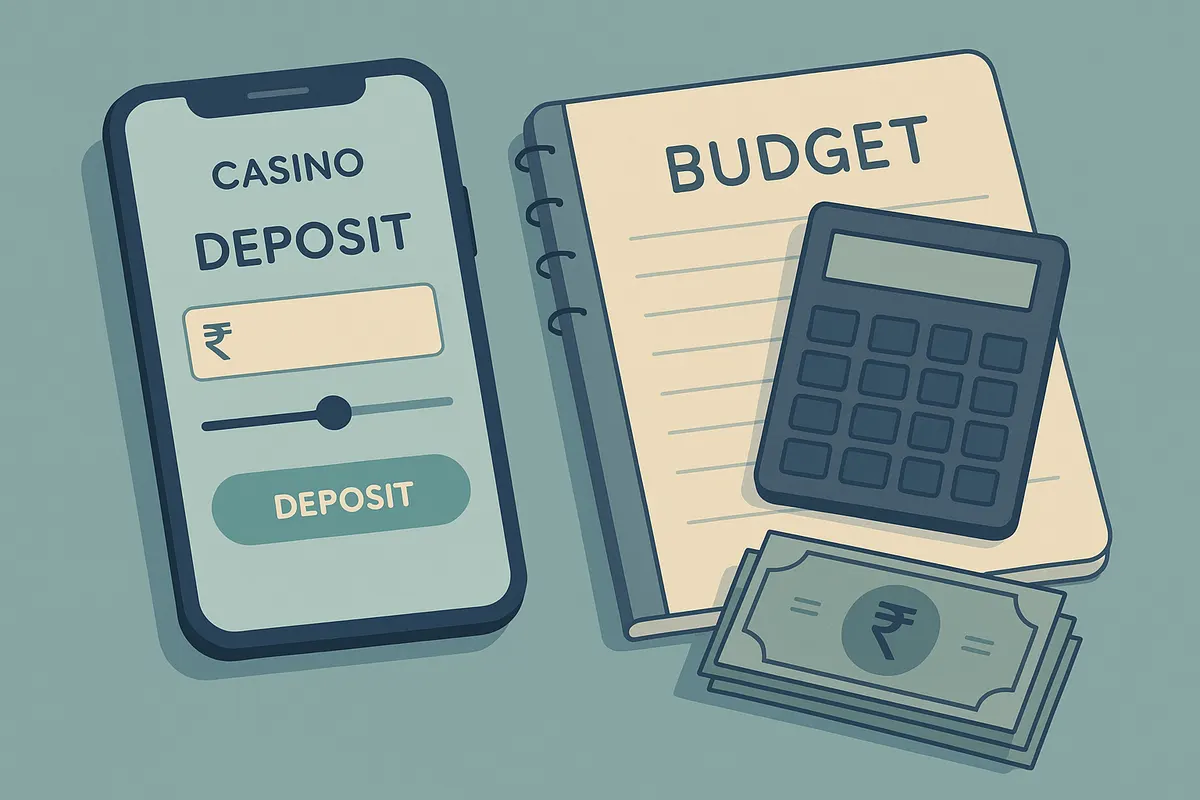
Responsible gambling advice starts with one non-negotiable: never stake money you cannot afford to lose. The commonly cited practical version is to cap gambling at a small share of disposable income — the money left after rent, EMIs, bills, groceries and savings. Five percent is the figure you will see most often. It is a guideline, not a law of finance, but it has the right shape: your entertainment budget scales with what you can genuinely spare, not with what you feel like betting tonight.
Run the arithmetic and the contrast with $48 a day becomes obvious. The table below is an illustration using round numbers, not a survey.
| Monthly take-home | Essentials + savings | Disposable income | 5% gambling cap (month) | Daily equivalent |
|---|---|---|---|---|
| ₹40,000 | ₹36,000 | ₹4,000 | ₹200 | ~₹7 |
| ₹60,000 | ₹50,000 | ₹10,000 | ₹500 | ~₹17 |
| ₹1,50,000 | ₹1,20,000 | ₹30,000 | ₹1,500 | ~₹50 |
At around ₹96 to the US dollar, $48.22 is roughly ₹4,630 — call it ₹1.4 lakh a month if repeated daily. Against the middle row of that table, that is a different universe. Even on a ₹1.5 lakh salary, a 5% cap lands near ₹50 a day, not ₹4,630.
Two caveats so the comparison stays fair. A monthly cap does not have to be spread evenly across 30 days; spending ₹500 in one session a month and nothing otherwise is the same budget. And in India, tax on net winnings plus GST on the money you put into play both eat into anything you get back, so the real cost of play is higher than the wager total suggests. Treat that as general information and check current rules or a tax professional for your own situation.
Percentage rules, willpower or hard limits: which control actually works?
A budget in your head is the weakest form of protection, because the moment you most need it — three losses deep, wanting one more spin — is the moment your judgement is worst. Chasing losses is a known behavioural trap, not a character flaw, and every RNG outcome is independent, so a losing streak gives you zero reason to expect a correction.
That is why account-level tools beat mental rules. Here is how the main options compare.
| Tool | What it caps | Main strength | Weak spot |
|---|---|---|---|
| Deposit limit | Money moved in per day/week/month | Caps true cost; easiest to match to a budget | Does nothing about recycled winnings or time spent |
| Loss limit | Net losses over a period | Directly targets the number that hurts | Not offered by every operator |
| Wager/bet limit | Stake size per round | Slows burn rate on high volatility games | Small stakes plus long sessions still add up |
| Session/time limit | Minutes played | Breaks autopilot play | No cap on money if stakes are large |
| Cool-off | Access for days or weeks | Interrupts a chasing cycle immediately | Temporary by design |
| Self-exclusion | Access for months or permanently | Strongest protection available | Only helps if applied across every account |
The verdict: a deposit limit is the single most effective control for most players, because it is the only one that binds the cash leaving your bank account, and because increases usually take effect only after a cooling-off delay while decreases apply at once. Pair it with a loss limit if your operator offers one, and a session reminder if you lose track of time. Percentage rules are how you calculate the number; the deposit limit is how you enforce it.
How to set deposit limits that hold
Calculate your safe gambling budget
- Write down monthly take-home pay.
- Subtract rent, EMIs, utilities, groceries, transport, insurance, family support and a fixed savings transfer.
- Whatever remains is your disposable income. Take 5% of it — or less. This is your monthly gambling ceiling.
- Divide by four for a weekly figure. Assume the entire amount is gone the moment you deposit it; over time, the house edge makes that the expected outcome.
Turn the number into casino controls
Open account settings and look for responsible gambling, player protection or limits. Set the monthly deposit limit to your calculated figure, then set a weekly and daily limit beneath it so one bad evening cannot consume the month. Do this while you are calm, not mid-session. If a site makes limits hard to find or pushes back on lowering them, that tells you something about the operator — a licensed site treats these tools as standard. Our responsible gambling guide and bankroll management walkthroughs cover the settings screen by screen.
When to lower your limits
Lower them when your income drops or an unexpected expense lands, when you notice you are hitting the cap every single month, when you have topped up outside your plan, or when playing has started feeling like work rather than entertainment. Reductions normally apply immediately. If you have thought about raising a limit more than once in a month, that thought is the signal — take a cool-off instead.
Red flags: when spending stops being entertainment
Responsible gambling data and clinical guidance point at behaviour patterns rather than a rupee threshold. Watch for these:
- Betting bigger after losses to get back to even.
- Depositing money meant for rent, EMIs, bills or savings.
- Borrowing, using credit, or selling something to fund play.
- Hiding the amount or the time spent from a partner or family.
- Failing to stop at a limit you set for yourself.
- Playing to escape stress, boredom, anxiety or low mood.
- Sleep, work or relationships slipping because of it.
Two or three of those together is worth acting on now, not later. Set a cool-off or self-exclusion, remove stored payment methods, and talk to someone. In India, the national Tele-MANAS mental health helpline (14416) offers free, confidential support, and Gamblers Anonymous groups meet in several cities and online; confirm current contact details before you call. Gambling has a built-in house edge, so it cannot function as income or a way out of a financial hole — if that is the role it is playing, stop and get help.
FAQ
How much do casino players spend daily?
There is no universal figure. Leaked operator documents from Curaçao put the average at about $48.22 a day per online player in Chile in 2024, with roughly $47.49 projected for the following four years. That is one market’s internal estimate, and averages are skewed upward by heavy spenders.
What is average casino spending, and is it a target?
An average is a mean, which in gambling data usually sits well above what a typical player spends. It is a market metric for operators, not a benchmark for you. Your own number should come from your disposable income, not from anyone else’s average.
How do I set casino deposit limits?
Go to your account’s responsible gambling or limits section, then set daily, weekly and monthly deposit caps matched to your budget. Reductions usually apply immediately; increases typically require a waiting period, which is the point.
Why do players overspend at casinos?
Mostly through loss chasing, plus the illusion that a losing run is “due” to turn. Outcomes are generated randomly and independently, so past results change nothing. Fast round times and frictionless top-ups also make small deposits accumulate faster than people track them.
Gambling is entertainment with a negative expected return over time, and it is for adults of legal age only. Play only with money you can afford to lose, and check the rules that apply where you live.