
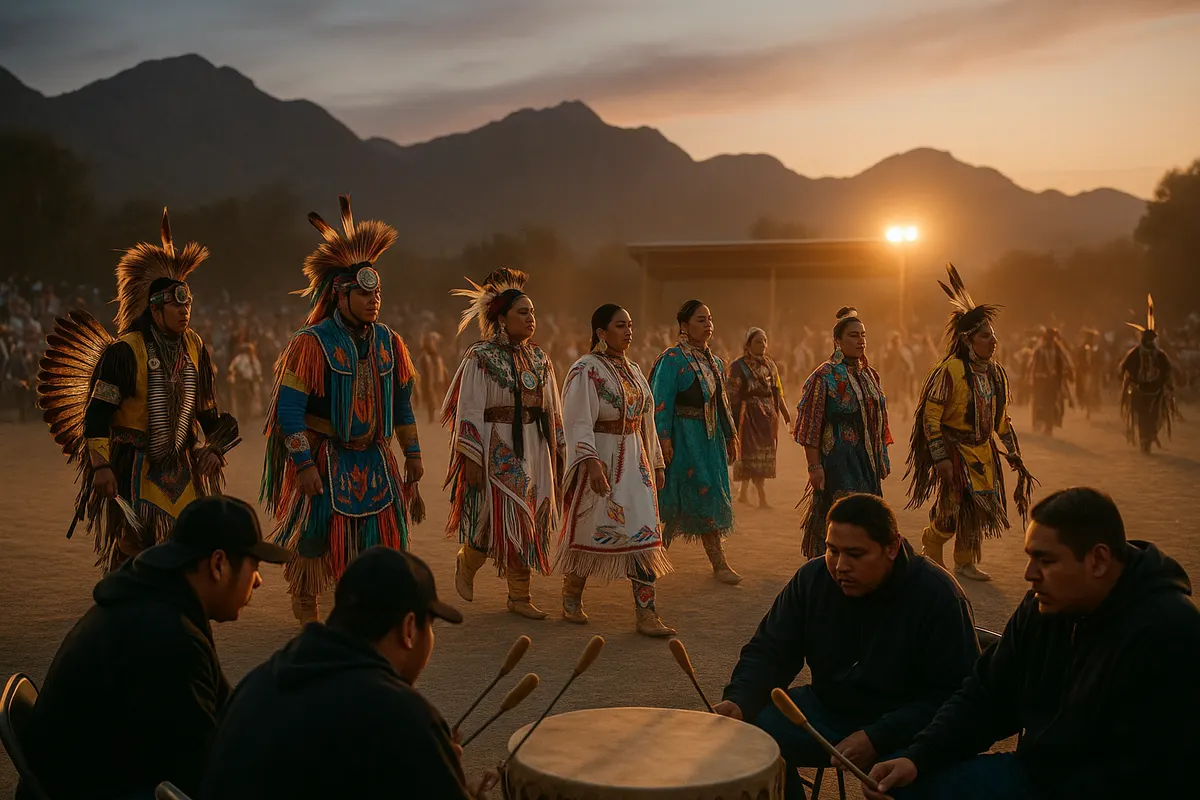
The drum lands first, then the bells. Several hundred dancers move into the arena at Banning, California, in leather, beadwork and feathers that took months of someone’s evenings to make, and for about twenty minutes nobody in the crowd of 30,000 is thinking about slot floors, hold percentages or compact renegotiations. That is the part of tribal gaming culture the industry press usually skips, and it is the part that explains most of the rest.
The 35th Annual Morongo Thunder & Lightning Powwow ran September 25–27 on the Morongo Indian Reservation, opening on California Native American Day. More than 900 dancers and 20 drum groups travelled from across the United States and Canada. Admission was free. A few minutes down Interstate 10 sits the tribe’s casino resort, which is how a free three-day cultural event of that size gets paid for in the first place.
The event, in numbers worth keeping
- More than 30,000 spectators over three days
- 900-plus competitive dancers, 20 drum groups, from the US and Canada
- 115-plus vendors at the Morongo Indian Market, selling baskets, beadwork, jewellery, pottery and clothing
- Traditional Bird Singing and peon games of the Morongo Band of Mission Indians and other Southern California tribes
- Grand Entry each day; free admission throughout
Tribal Chairman Charles Martin framed the weekend as renewing a commitment to tradition and passing heritage on through young people. That is not marketing copy bolted onto a casino promotion. It is, more or less, the stated purpose of the whole enterprise, and it is written into the federal law that made the enterprise legal.
Two ways to run a casino, side by side
The useful comparison here is not “tribal casinos versus commercial casinos” as venues. Walk both floors and you will find the same slot cabinets from the same suppliers, similar RTP ranges, the same live blackjack rules. The difference is upstream: who owns the operation, who regulates it, and where the money is legally required to go.
| Tribal gaming (US) | Commercial casino gaming | |
|---|---|---|
| Owner | A sovereign tribal government, on behalf of its members | Private or publicly listed company, on behalf of shareholders |
| Legal basis | Indian Gaming Regulatory Act (1988) plus a tribal-state compact for Class III games | State licensing statutes |
| Regulator | Tribal gaming commission, with federal oversight from the National Indian Gaming Commission | State gaming board or commission |
| Where net revenue must go | Restricted by IGRA to tribal government operations, member welfare, economic development, charitable giving and local government agencies | Unrestricted after tax; distributed as profit |
| Community function | Funds health, housing, education, language and cultural programmes | Employment and tax contribution |
| Expansion logic | Constrained by land status, compacts and member consent | Constrained by capital and licence availability |
That revenue-allocation column is the whole story. A commercial operator can spend its profit on a share buyback. A tribal operator cannot, because IGRA lists the permitted uses. A free powwow drawing 30,000 people and a hundred-plus artisan vendors is a textbook example of the charitable and general-welfare categories in action, which is why these events tend to grow alongside successful casino operations rather than in spite of them.
A short tribal casino history: the law arrived second
Gaming on reservations did not begin with a business plan. It began with bingo halls in the late 1970s and early 1980s, states trying to shut them down, and the courts declining to let them. The Morongo Band was one of the tribes in the 1987 US Supreme Court case California v. Cabazon Band of Mission Indians, which found that California could not enforce its gaming regulations on tribal land where such gambling was otherwise permitted in the state. Congress responded the following year with IGRA, which created the three-class system still in use: Class I traditional and ceremonial games left entirely to tribes, Class II bingo and certain card games, Class III slots and table games requiring a negotiated compact with the state.
California then took twelve more years to sort out Class III. Proposition 1A, approved by voters in 2000, amended the state constitution to authorise tribal casino gaming, which is why the large Southern California resorts date from roughly that period. Nationally, the National Indian Gaming Commission publishes annual gross gaming revenue for the sector; the figures run into the tens of billions of dollars, making tribal gaming a substantial slice of the US market rather than a curiosity. Check the NIGC for the current year’s numbers before quoting any.
Peon, hand games, and the honest version of gaming heritage
The peon games at Morongo are worth pausing on, because they complicate the tidy narrative in both directions. Peon is a team guessing game — hidden markers, concealed hands, singing, reading the other side — played in Southern California long before anyone built a resort off the freeway. Wagering has historically been part of that tradition, as it has in hand games across many North American cultures.
What it is not is a prototype slot machine. Peon is social, communal, sung, and played between teams who know each other. A modern slot is a solitary transaction with an RNG and a fixed house edge. Anyone selling you a straight line from traditional games to the casino floor is selling you something. The genuine continuity is narrower and more interesting: games as community events, with stakes that mattered inside a relationship rather than to a balance sheet. That thread runs through the powwow arena, not the pit.
Where this collides with online gaming
For iGaming readers, the practical consequence is that tribes are not slow-moving incumbents who missed the digital memo. They are governments with a legal claim to gaming on their lands, and online wagering makes “on their lands” a genuinely hard question. Where does a bet exist — on the phone, or on the server?
California answered nothing in November 2022, when voters rejected both ballot measures on the table: Proposition 26, the tribal-backed in-person sports betting proposal, and Proposition 27, the commercial online proposal that tribal coalitions campaigned hard against. Both failed. In Florida, by contrast, the Seminole Tribe’s compact routes online sports wagers through servers on tribal land, treating the bet as occurring there. That server-location model is the template most tribal operators are watching.
Read the Morongo powwow next to that and the caution makes sense. When your gaming revenue funds the housing budget, the clinic and the language programme, handing distribution to a third-party app with a market-share war attached is a governance decision, not a growth opportunity. Operators and suppliers who pitch tribal partnerships as pure user-acquisition maths tend to get short meetings.
The verdict
If you are comparing the two models purely as businesses, the commercial one is faster, more liquid and easier to scale. On the measure tribal operators actually use — what the money does when it leaves the cage — the tribal model is doing something the commercial one was never designed to do. Neither changes the maths at the table. A 2.7% house edge on European roulette is 2.7% whoever owns the building, and a 96% RTP slot is a long-run average across millions of spins, not a promise about your evening.
What the 30,000 people at Banning show is the difference in what the edge pays for. That is the part of tribal gaming culture worth understanding before you write your next sentence about “the tribal segment”.
Common questions
Do tribal casinos pay tax?
Tribes are governments, so gaming revenue held by the tribe is not subject to federal corporate income tax. Distributions to individual members are taxable to those members, and many state compacts include revenue-sharing payments to the state. Specifics vary by compact; this is general information, not tax advice.
Can I play at a Native American casino online?
Only where state law and the relevant compact allow it. Several tribes operate licensed sports betting apps in states that have authorised them; online casino gaming is far more limited. There is no blanket national permission, and offshore sites claiming tribal affiliation should be treated with suspicion.
Are the games different from commercial casinos?
Class III floors use the same certified slot titles and table rules you will find elsewhere. Class II machines look like slots but are legally bingo-based, with the result determined by a bingo draw behind the reel animation. RTP and volatility disclosures work the same way.
However the ownership is structured, the house keeps an edge over time. Set a deposit or loss limit before you play, treat the spend as entertainment rather than income, and use self-exclusion or cool-off tools if play stops feeling optional.